Should you choose porcelain or ceramic tile for your bathroom? The answer depends on where the tile goes, how it is finished, and how it is installed. Rectified edges, grout spacing, tile warpage and lippage can matter just as much as the color you choose.
Porcelain vs. ceramic tile: what is the difference?
Porcelain is a type of ceramic tile, but not all ceramic tile is porcelain. The defining distinction is water absorption: porcelain absorbs 0.5% or less by weight when tested according to the applicable standard. Non-porcelain ceramic tile absorbs more. Both can be appropriate in bathrooms when the individual product is rated for the intended application. The Tile Council of North America explains the material differences.
| Feature | Porcelain | Non-porcelain ceramic |
|---|---|---|
| Water absorption | 0.5% or less | Greater than 0.5% |
| Cutting | Often more demanding | Often easier |
| Shower walls | Suitable when approved | Suitable when approved |
| Bathroom floors | Choose floor-rated products | Choose floor-rated products |
| Typical cost | Often higher | Often lower |
Where should each type of tile go?
Shower walls
Porcelain and shower-rated ceramic can both work well. Porcelain is popular for large-format stone-look surfaces; ceramic offers excellent decorative and subway-tile choices. Neither tile nor grout replaces a correctly designed waterproofing assembly. See our guide to what goes behind shower tile.
Bathroom floors
Choose a floor-rated tile with an appropriate wet-use surface. Porcelain is frequently a strong option for busy bathrooms, but the manufacturer’s intended-use rating and slip-resistance information matter more than the material name alone.
Shower floors
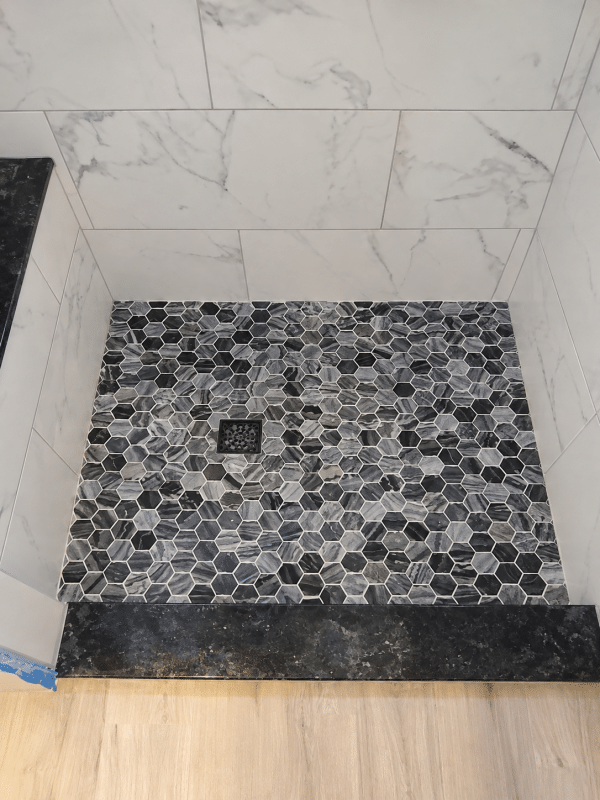
Smaller mosaics can follow the slope to a drain more easily than large tiles. Select tile specifically suitable for shower floors, with appropriate traction and drainage. Do not assume that grout joints alone make a slippery tile safe.
Rectified vs. non-rectified tile: why the edges matter
Rectified tile has edges mechanically finished to more consistent dimensions. This creates crisp lines and can support relatively narrow grout joints when the tile, substrate and installation requirements allow. Non-rectified or pressed-edge tile retains its manufactured edge, which may be rounded, cushioned or otherwise less dimensionally uniform. It often calls for wider joints.
Importantly, porcelain versus ceramic describes a material classification; rectified versus non-rectified describes edge finishing. A porcelain tile can be rectified or non-rectified.
Rectified edge
Crisp, dimensionally consistent edges; narrow joints can emphasize unevenness.
Pressed or cushioned edge
Softer edge profile, often paired with more visible grout joints.
Original simplified illustrations: edge shapes are schematic, not dimensional installation drawings. For more technical detail, see the TCNA discussion of rectified tile and narrow grout joints.
What is tile lippage?
Lippage is the difference in height between adjacent tile edges. Excessive lippage can create visible shadows, uncomfortable raised edges or a poor finished appearance. Causes include an uneven substrate, allowable tile warpage, thickness variation, layout and installation technique. Strong side lighting can make it more obvious. The TCNA lippage guidance explains the standards and contributing factors.
Tile leveling clips can assist with alignment, but they do not replace preparing the floor or wall to the required flatness. A large tile laid on an uneven surface can still have problems even when clips are used.
Large-format tile and the 50% offset problem
Large-format tile can create a clean, contemporary bathroom with fewer grout joints. However, long rectangular tiles sometimes have slight curvature. A 50% running-bond pattern aligns the center of one tile with the end of its neighbor, potentially emphasizing lippage. For certain large tiles, industry guidance commonly limits offsets to 33% unless manufacturer guidance and the installation evaluation support another layout.
Original schematic illustrations of running-bond patterns; not installation specifications.
How wide should grout joints be?
Grout-joint width is not just a style choice. It depends on dimensional variation, edge shape, tile size and layout. Tight joints make irregularities more visible. A commonly used guideline is a joint at least three times the actual variation in tile facial dimensions; the final width must satisfy the applicable standard and manufacturer’s instructions. For example, a measured 1/16-inch size variation suggests at least a 3/16-inch joint under that guideline. See the TCNA grout-joint explanation.
Grout is not waterproofing, and movement joints at changes of plane require appropriate treatment. The goal is not to eliminate grout; it is to use a suitable grout and joint width for the installation.
What really affects tile installation cost?
The price printed on a tile sample is only part of the total cost. Surface preparation, tile size, cutting difficulty, niche and bench details, patterns, waterproofing and grout all affect labor and materials. Large-format rectified porcelain with complex cuts may cost more to install than straightforward ceramic tile, even if the tile purchase prices are similar.
For budgeting, see where the money goes in a $25,000 bathroom remodel and our remodeling cost estimator.
Spot-On bathroom tile selection matrix
This original decision framework is a starting point, not a substitute for product specifications.
| Location | Good starting choice | Top priority |
|---|---|---|
| Main bathroom floor | Floor-rated porcelain or ceramic | Wet traction and maintenance |
| Shower wall | Shower-rated porcelain or ceramic | Waterproofing and layout |
| Shower floor | Wet-area-rated mosaic | Slope, drainage and traction |
| Shower niche | Porcelain or ceramic | Waterproof details and clean edges |
| Large contemporary wall | Rectified tile | Flat substrate and lippage control |
| Traditional wall | Pressed-edge ceramic | Design and grout-joint appearance |
What will your tile look like in 10 or 20 years?
Consider cleaning requirements, grout color, surface texture, availability of replacement tile and the waterproofing system underneath. A highly polished finish may show water spots and may not be appropriate for a wet floor. Keep spare tile for future repairs and follow the manufacturer’s cleaning guidance. Homeowners planning for long-term comfort should also consider aging-in-place bathroom design.
Real construction experience: the work behind the finish
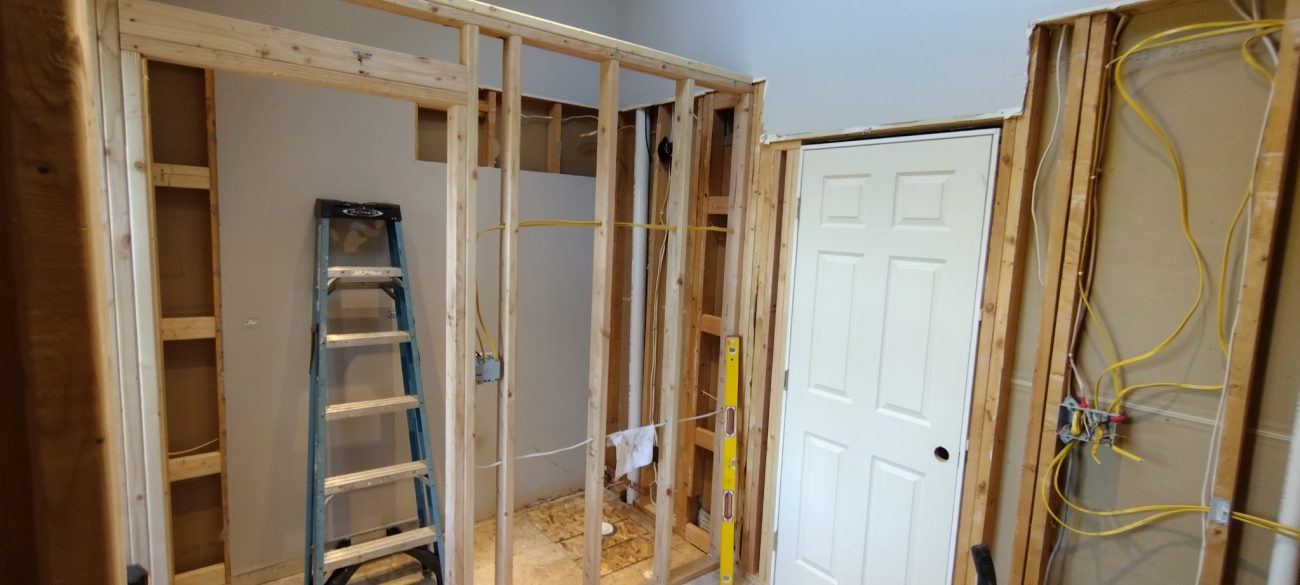
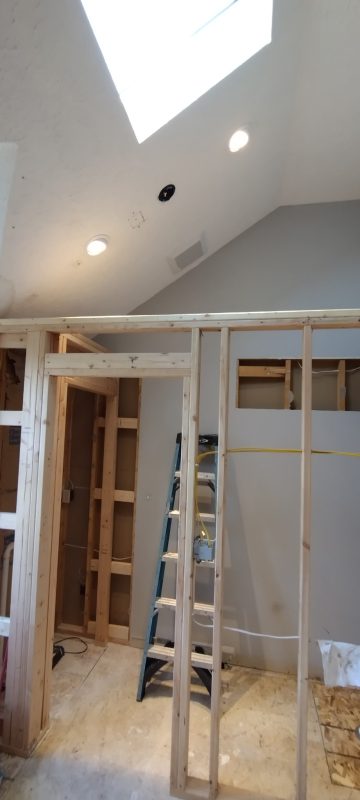
In a Rocky River bathroom remodel, Spot-On relocated the shower to the former tub area, incorporated a bench and niche, and improved the room’s layout, lighting and storage. These features require planning before the first finish tile is set. Tile dimensions influence the niche layout, bench details and transitions.
Explore the complete Rocky River bathroom remodeling project.
Frequently asked questions
Is porcelain always better than ceramic?
No. Porcelain’s low water absorption is useful, but correctly rated ceramic tile can be an excellent choice, especially for walls.
Is rectified tile worth it?
It can be for a crisp, modern look. Expect careful layout, substrate preparation and appropriate grout joints.
Can tile be installed without grout?
No. A typical tile installation needs joints; rectified edges do not remove that requirement.
Why are some tile edges higher than others?
That is lippage. Tile warpage, uneven surfaces, layout and installation methods can all contribute.
Should shower floors use smaller tile?
Smaller mosaics often work well with traditional slopes, but the product’s wet-area suitability and drainage design still need to be verified.
Does porcelain make a shower waterproof?
No. The waterproofing system beneath the tile protects the surrounding structure.
Planning a bathroom remodel in Cleveland or Akron?
Spot-On Home Improvements has served homeowners since 2013. We help plan and complete bathroom remodeling projects in Cleveland, Akron and surrounding cities, including Lakewood, Hudson, and Strongsville.
Explore our bathroom remodeling services or contact Spot-On Home Improvements to discuss your project. When Quality Matters.