Blog
A bathroom remodel is expensive enough the first time. Nobody wants to stand in that same bathroom eight or ten years later and think: We should have done this differently.
Sometimes bathrooms get remodeled again because they’re worn out. But sometimes the problem isn’t age at all.
The layout doesn’t work anymore. The trendy tile already looks dated. The shower is difficult to get into. There’s nowhere to store anything. Water has gotten somewhere it shouldn’t.
A homeowner discovers that adding a grab bar now means opening a beautifully tiled wall because nobody thought about putting blocking behind it.
Or something that seemed like a great design choice at 45 becomes irritating at 60. That’s why there’s another way to approach bathroom remodeling.
Don’t just build your next bathroom. Build your 20-year bathroom.
At Spot-On Home Improvements, our goal is to help you make the smartest decision for your home—even if you don’t hire us.
So let’s look at what we’d think about if the goal weren’t simply to make your bathroom look great on completion day—but to make you still glad you remodeled it 20 years from now.
What Is a 20-Year Bathroom?
Let’s establish something first.
We’re not promising that every faucet, toilet, light fixture, caulk joint or painted surface will last untouched for exactly 20 years.
Things wear out. Styles change. Products need maintenance. Sometimes fixtures eventually need replacing.
A 20-year bathroom is something different.
It’s a bathroom whose bones don’t need to be torn apart simply because your needs changed or because shortcuts were taken during construction.
Think about the difference.
Replacing a faucet is relatively easy. Replacing a vanity is manageable.
Changing a mirror or light fixture isn’t a major renovation. But tearing apart a tiled shower because of a waterproofing problem?
Moving walls because the original layout was poorly planned?
Removing tile because you need accessibility features that could have been anticipated?
That’s remodeling the bathroom again. Our goal is to avoid that.
1. Spend Your Money Behind the Tile First
If you’re building a bathroom to last, this may be the most important principle in this entire article:
The parts you can’t see may matter more than the parts you can.
Homeowners naturally get excited about tile, faucets, vanities and shower glass. We understand. That’s the fun stuff.
But a beautiful shower is still only as good as what’s behind it.
Tile and grout themselves are not inherently waterproof. A tiled wet area needs an appropriate waterproofing system beneath the finished surface to manage moisture. Schluter, one major manufacturer of tiled-shower systems, explains this distinction in its technical information about tiled shower waterproofing.
That’s why we’d rather see a homeowner spend money on:
Proper waterproofing. Good substrate preparation. Correct drainage. Quality plumbing work. Solid framing.
Before spending the last available dollars on decorative upgrades.
You can change a $150 shower head later. You don’t want to replace the wall behind it.
2. Don’t Design Around a Trend
There’s nothing wrong with having style.
The mistake is confusing style with fashion.
If you’re trying to build a bathroom that still looks good 15 or 20 years from now, be careful with expensive permanent materials that are extremely tied to one moment in design.
Remember:
The harder something is to replace, the more timeless it should probably be.
That doesn’t mean your bathroom has to be boring.
It means putting personality in places that are easier to change.
A simple tile can last through several decorating cycles.
Paint can change. Mirrors can change. Hardware can change. Towel bars can change. Lighting can change. And you accessories can change.
Put trends on the surface. Put timeless decisions underneath them.
That’s a much cheaper way to fall in love with your bathroom again ten years from now.
3. Think Very Carefully Before Moving the Plumbing
Sometimes moving plumbing transforms a bad bathroom. That’s when it’s worth discussing.
Other times, a homeowner spends thousands rearranging fixtures and ends up with a bathroom that functions almost exactly as it did before.
For a long-term remodel, ask:
What problem does moving this actually solve?
Does it create a larger shower? Will it improve traffic flow? What about creating more storage? Should I give the toilet more privacy? Should it allow two people to use the room comfortably?
If the answer is meaningful, investigate it.
If the answer is basically “I thought the toilet would look better over there,” we’d look very carefully at whether that’s the best place for your remodeling dollars.
4. Build the Shower for the Person You’ll Be Later
This is where the 20-year concept becomes really interesting.
Suppose you’re 45 today. Twenty years from now, you’ll be 65. If you’re 55, you’ll be 75.
That doesn’t mean your bathroom should look like a medical facility. It means good design can anticipate change without announcing that it did.
A lower-threshold or curbless shower can look fantastic today while becoming considerably more useful later. A handheld shower on a slide bar can feel luxurious today and provide flexibility later. A shower bench can be convenient now and important someday. And well-placed controls can make a shower easier for practically everyone to use.
And here’s a big one:
Put blocking in the walls before they’re closed.
The National Association of Home Builders‘ aging-in-place remodeling guidance specifically recommends wall reinforcement around showers, tubs and toilets so grab bars can be installed when needed. NAHB also identifies curbless showers, handheld showerheads and slip-resistant flooring among useful long-term bathroom features.
You don’t necessarily need grab bars today.
But if the wall is already open during a remodel, preparing for them is a very different proposition from tearing into finished tile years later.
That’s what future-proofing actually means.
5. Stop Thinking of Aging-in-Place as “Old-People Design”
This is a mistake I’d like to see disappear.
Consider these features: A wider doorway. Better lighting. A shower without a high obstacle at the entrance. A handheld shower. A comfortable-height toilet. Slip-resistant flooring. Easy-to-operate faucets. More maneuvering space.
Who exactly are those features bad for? Nobody.
They’re simply good design.
And homeowners are increasingly thinking this way. NAHB reported in 2025 that industry professionals had seen increased requests for aging-in-place features, with common changes including curbless showers, grab bars, wider doorways and higher toilets.
NAHB — Practical Strategies for Aging-in-Place Remodels
If you expect to remain in your house for many years, it makes sense to at least consider these decisions while you’re already remodeling.
6. Don’t Cheap Out on the Things You Touch Every Day
A bathroom gets used hard.
Think about how many times over 20 years you’ll: Turn on the faucet; Open a vanity drawer; Flush the toilet; Turn the shower valve; Open the shower door; Step onto the floor; Switch on the light; Pull on cabinet hardware.
Cheap components don’t always stay cheap when you have to replace them repeatedly.
That doesn’t mean everything needs to be luxury-grade.
It means we’d rather put money into durable, serviceable products from established manufacturers than spend heavily on something simply because it photographs well.
And whenever practical, think about replacement parts.
Twenty years from now, the ability to replace a cartridge or component can be much more valuable than having bought the most unusual faucet in the showroom.
7. Make Storage Part of the Architecture
One of the easiest ways to make a beautiful bathroom annoying is to forget where everything goes.
- Hair dryers.
- Towels.
- Toilet paper.
- Medicine.
- Cleaning products.
- Shampoo.
- Extra soap.
- Makeup.
- Razors.
All those things have to live somewhere. A bathroom designed only around photographs tends to look fantastic until humans move into it.
For a 20-year bathroom, think about storage before construction:
- Can the vanity have drawers instead of cavernous doors?
- Is there room for a recessed medicine cabinet?
- Can we build a useful shower niche?
- Is there linen storage?
- Where will towels actually hang?
- Where does the toilet paper go?
- Where will electrical grooming tools be stored?
Good storage doesn’t make a bathroom larger. It makes the bathroom you already have work larger.
8. Ventilation Isn’t the Place to Save $100
Bathrooms create moisture.
Lots of it.
And if you’re building for longevity, controlling that moisture matters.
A properly sized, appropriately installed exhaust fan can help remove humid air rather than allowing it to linger on walls, ceilings and other surfaces.
ENERGY STAR evaluates certified residential ventilation fans for factors including efficiency, airflow performance and sound. ENERGY STAR — Ventilation Fans
There’s another detail homeowners often overlook:
Noise matters.
If your exhaust fan sounds like a small airplane preparing for takeoff, you’re less likely to use it.
A quiet fan that’s actually used is considerably more useful than an obnoxious one that stays switched off.
9. Buy Fixtures for Performance, Not Just Appearance
A faucet can look great in a showroom.
A shower head can look impressive online.
A toilet can have a beautiful modern profile.
But these are working pieces of equipment.
They need to work.
For homeowners who also care about water consumption, EPA’s WaterSense program independently certifies qualifying fixtures for efficiency and performance. For example, WaterSense bathroom faucets use no more than 1.5 gallons per minute, and WaterSense showerheads no more than 2.0 gallons per minute while also meeting performance criteria.
EPA WaterSense — Your Better Bathroom
This is a perfect example of why we’d look beyond appearance when selecting products expected to serve a bathroom for years.
10. Make the Bathroom Easy to Maintain
Here’s an underrated remodeling question: How annoying will this bathroom be to clean?
That beautiful design you saw online might include 400 grout joints. Someone has to clean 400 grout joints.
Intricate surfaces, tiny tiles, hard-to-reach spaces, poorly positioned fixtures and unnecessary ledges can all create maintenance headaches.
Twenty-year design considers Tuesday morning—not just the reveal photograph.
Larger-format tile can mean fewer grout joints. A properly planned vanity can eliminate difficult cleaning gaps. Accessible plumbing components can make future service easier. Quality exhaust ventilation helps manage moisture. Simple floor transitions eliminate dirt traps.
The easier a bathroom is to maintain, the better chance it has of still looking good years from now.
11. Don’t Build Everything So Permanently That Nothing Can Change
This sounds contradictory. We’re trying to build a bathroom that lasts 20 years. But that doesn’t mean everything should be permanent.
The smartest long-term bathroom separates the difficult-to-change elements from the easy-to-change ones.
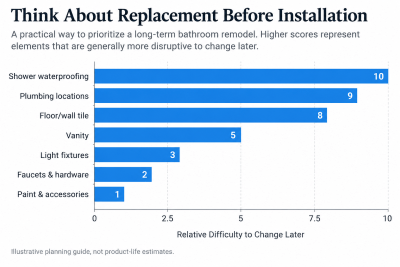
Bathroom Fixture Replacement Costs
Spend more planning time on the top of that chart. Those are the decisions that can require demolition to change.
The things near the bottom? Those are opportunities to update your bathroom later without remodeling it again.
12. Leave Yourself Options
One of the best things a remodel can give you isn’t a feature. It’s an option.
- Blocking behind a wall gives you the option to install grab bars later.
- A well-designed shower gives you options as mobility changes.
- Accessible plumbing makes repairs easier.
- A neutral permanent palette gives you decorating options.
- Adequate electrical planning gives you options for future devices.
- Good lighting gives you options as eyesight changes.
- A functional layout gives future owners options too.
You may never use every one of them. That’s okay.
Good planning doesn’t force your future. It gives your future choices.
Where I’d Spend the Money in a 20-Year Bathroom
If the budget forced us to choose between what’s underneath and what’s decorative, my priorities would look something like this:
| Priority | Spend Here First | Why |
|---|---|---|
| 1 | Waterproofing & wet-area construction | Failure can require major demolition |
| 2 | Plumbing & electrical fundamentals | Expensive and disruptive to change |
| 3 | Functional layout | Determines how the room works every day |
| 4 | Flooring & permanent tile | Difficult to replace casually |
| 5 | Ventilation | Helps manage bathroom moisture |
| 6 | Quality vanity/storage | Daily function and organization |
| 7 | Fixtures | Performance and serviceability matter |
| 8 | Decorative elements | Easiest things to change later |
Notice what’s not first? The fancy mirror. The $900 faucet. The designer towel bar.
Those can be wonderful additions, but they don’t make a bathroom last 20 years.
The $500 Decision That Could Save You Thousands Later
This is the mindset I’d like homeowners to take from this article.
During a remodel, there are moments when doing something now is relatively easy because the room is already torn apart.
Later, the exact same change could mean demolition.
- Maybe it’s blocking behind a wall.
- Maybe it’s upgrading the exhaust fan.
- Maybe it’s replacing questionable plumbing while it’s exposed.
- Maybe it’s changing an awkward doorway.
- Maybe it’s improving shower access.
The exact decision will differ from house to house.
But the question should always be:
“While everything is open, is there anything we’re going to wish we’d done ten years from now?”
That’s a much better question than simply:
“What’s the cheapest way to finish this bathroom?”
A Bathroom Should Age With the House—and With You
Nobody can predict exactly what they’ll want 20 years from now.
We can’t predict every style. We can’t predict every new product. And we certainly can’t guarantee that nothing in a bathroom will ever need repair or replacement.
But we can make better decisions today. Build the wet areas correctly; Create a functional layout; Use durable permanent materials; Plan storage; Control moisture; Think about accessibility before it’s necessary; Make decorative elements easy to change; And spend money on the things that would be expensive to correct later.
That’s the difference between remodeling a bathroom to look good today and remodeling one to continue working well for years.
The best 20-year bathroom isn’t the bathroom that never changes. It’s the bathroom you don’t have to tear apart in order to change with it.
If you’re planning a bathroom remodel in Cleveland or Akron, Ohio or a surrounding city, Spot-On Home Improvements can help you look beyond the finished picture and think through how the bathroom will actually work for your home.
When Quality Matters.
Frequently Asked Questions
Can a bathroom remodel really last 20 years?
The underlying bathroom absolutely can be designed with long-term use in mind, although individual fixtures, finishes and maintenance items may need repair or replacement along the way. The objective is to avoid unnecessarily tearing apart the major construction because of poor planning or premature failures.
What bathroom features are worth spending more money on?
Prioritize difficult-to-replace components: waterproofing, wet-area construction, plumbing and electrical fundamentals, subfloor preparation, permanent tile and a functional layout.
What bathroom trends are most likely to become dated?
Rather than trying to predict which particular style will fall out of fashion, use highly distinctive trends on things that are relatively inexpensive to change. Keep difficult-to-replace surfaces more versatile if longevity is the goal.
Should I install grab bars even if I don’t need them?
Not necessarily. But if the walls are already open, installing appropriate reinforcement can make adding them later considerably easier. NAHB includes wall reinforcement for future grab bars in its aging-in-place remodeling recommendations.
Is a curbless shower worth considering?
It can be. Curbless showers can create a clean contemporary appearance while eliminating a step into the shower, which may become useful as mobility needs change. NAHB includes curbless showers among its independent-living and aging-in-place recommendations.
What is the biggest mistake when planning a long-term bathroom?
Focusing almost entirely on visible finishes while underinvesting in the construction, waterproofing, layout and infrastructure underneath them.