Blog

If you’ve ever received a bathroom remodeling estimate for $20,000, $25,000 or more and thought, “How can one little room possibly cost that much?” you’re not alone.
A bathroom may be one of the smallest rooms in your house, but it can also pack more skilled trades, materials and technical work into each square foot than almost any other room.
Plumbing. Electrical. Waterproofing. Tile. Carpentry. Drywall. Painting. Fixtures. Ventilation. Demolition. Disposal. Project management.
They’re all squeezed into a room that might be only 40 to 80 square feet.
So instead of simply telling you that a bathroom remodel can cost $25,000, let’s do something more useful:
Let’s take the $25,000 apart and see where the money actually goes.
At Spot-On Home Improvements, our goal is to help you make the smartest decision for your home—even if you don’t hire us.
First: Is $25,000 a Normal Bathroom Remodeling Budget?
It can be.
But there’s an important distinction between asking “What does a bathroom remodel cost?” and “What does my bathroom remodel cost?”
There isn’t one universal answer.
A cosmetic refresh involving paint, a vanity and a few fixtures is completely different from a full bathroom renovation involving demolition, a new tub or shower, waterproofing, tile, plumbing and electrical work.
The condition and age of the house matter, too.
In Cleveland and Akron, contractors frequently work in older housing where opening a wall or floor can reveal conditions that weren’t visible during the estimate.
That’s why a homeowner should be suspicious of anyone who promises an exact remodeling price without first understanding the scope of work.
For this example, we’re going to assume a full, professionally completed bathroom remodel with midrange materials and a hypothetical total project budget of exactly $25,000.
A Sample $25,000 Bathroom Remodel Breakdown
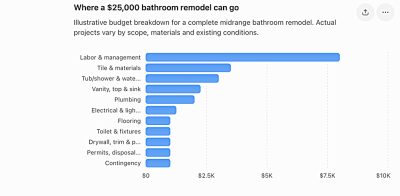
Here’s one realistic way that budget could be distributed:
| Category | Example Budget | Share |
|---|---|---|
| Labor & project management | $8,000 | 32% |
| Tile & installation materials | $3,500 | 14% |
| Tub/shower & waterproofing | $3,000 | 12% |
| Vanity, top & sink | $2,250 | 9% |
| Plumbing | $2,000 | 8% |
| Electrical & lighting | $1,250 | 5% |
| Flooring | $1,000 | 4% |
| Toilet & fixtures | $1,000 | 4% |
| Drywall, trim & paint | $1,000 | 4% |
| Permits, disposal & miscellaneous | $1,000 | 4% |
| Contingency / unforeseen conditions | $1,000 | 4% |
| TOTAL | $25,000 | 100% |
Important: This isn’t a Spot-On quote or a promise that these percentages apply to every project. It’s an educational example showing how quickly the components of a complete remodel can add up.
Bathroom Remodel Budget Breakdown
1. Labor and Project Management: $8,000
This is often the part homeowners underestimate.
You’re not simply paying someone to “put in a bathroom.”
A complete remodel can involve demolition, carpentry, plumbing, electrical work, drywall, waterproofing, tile installation, finish carpentry, painting and fixture installation.
And those jobs have to happen in the correct order.
A contractor also has costs that aren’t sitting visibly inside your bathroom: scheduling trades, obtaining materials, protecting the house, hauling debris, managing subcontractors, coordinating inspections, correcting unexpected conditions and standing behind the finished project.
That’s why comparing two estimates based only on material prices can be misleading.
You’re purchasing both the physical bathroom and the process required to build it correctly.
2. Tile and Installation Materials: $3,500
Tile is a perfect example of why homeowners can underestimate remodeling costs.
You see a tile advertised for $4.99 per square foot and think:
My bathroom isn’t that big. How expensive could this be?
But the tile itself is only one component.
A tiled bathroom may require backer materials, mortar, grout, leveling products, edging or trim pieces, spacers or leveling systems, sealants and considerable installation labor.
Patterns matter too.
Straightforward tile installations generally require less labor than complicated layouts, niches, mosaics and other detail work.
The tile you choose matters—but what you ask someone to do with it matters just as much.
3. Tub, Shower and Waterproofing: $3,000
This is one place where saving money the wrong way can become very expensive later.
The attractive tile is what you see.
The waterproofing behind it is what protects your house.
A properly constructed wet area requires a complete system behind the finished surface. The exact system varies by application, but water management shouldn’t be treated as an optional upgrade.
A shower that looks fantastic on completion day but allows moisture into the wall isn’t a successful remodel.
It’s a future repair.
4. Vanity, Countertop and Sink: $2,250
Here’s another category with enormous price variation.
A basic stock vanity and a furniture-style or semi-custom vanity aren’t comparable products. Countertop material, cabinet construction, size, storage features, sinks, faucets and installation all affect the final number.
This is also an excellent place to control a remodeling budget.
If the existing layout works well, choosing a sensibly priced vanity can give the room a dramatic visual transformation without spending money moving plumbing around the room.
5. Plumbing: $2,000
Plumbing costs depend heavily on one question:
Are we leaving everything where it is?
Keeping the toilet, sink and tub/shower in approximately the same locations can substantially simplify a renovation.
Moving them can mean opening floors and walls, relocating supply lines and drains, and potentially addressing venting and other conditions.
That’s why one of our first questions when discussing a bathroom layout is:
What problem are we solving by moving this fixture?
Sometimes moving it dramatically improves the bathroom.
Sometimes you’re spending thousands of dollars to move a toilet three feet without meaningfully improving the room.
That’s money that might be better spent elsewhere.
6. Electrical and Lighting: $1,250
Older bathrooms weren’t designed around today’s electrical needs.
A renovation may involve updated lighting, switches, receptacles, exhaust ventilation and other electrical work depending upon the existing system and project scope.
This is another reason remodeling an older Cleveland or Akron home isn’t necessarily comparable to renovating a recently constructed house.
What already exists behind the walls matters.
7. Flooring: $1,000
A bathroom floor is small, so flooring should be cheap, right? Sometimes. But square footage isn’t the only factor.
Removal of the existing floor, subfloor condition, preparation, transitions, toilet removal/reinstallation and the complexity of the chosen flooring all contribute to cost.
And demolition occasionally reveals something nobody wanted to find: a damaged subfloor.
If years of leakage around a toilet, tub or shower have damaged the wood underneath, covering it with a beautiful new floor doesn’t solve the problem.
The damaged material needs to be addressed first.
8. Toilet and Finish Fixtures: $1,000
Individually, these purchases may not seem significant.
Then you start adding them:
Toilet. Faucet. Shower trim. Towel bars. Toilet-paper holder. Mirror. Shower accessories. Hardware.
One $100 decision isn’t usually what blows a remodeling budget.
Twenty “it’s only another $100” decisions can.
That’s why fixture selections should be made with an overall allowance in mind instead of choosing every item independently.
9. Drywall, Trim and Painting: $1,000
Eventually all the construction work has to disappear.
Walls need to be repaired and finished. Trim needs to be installed. Nail holes need filling. Caulk joints need finishing. Everything needs painting.
These finishing details aren’t usually what homeowners get excited about when designing a bathroom.
But they’re often what separates a bathroom that feels professionally remodeled from one that simply contains new materials.
10. Disposal and Miscellaneous Costs: $1,000
This might be the least glamorous $1,000 in the entire bathroom remodel.
When the project is finished, you don’t get to point at any of it and say, “There’s my thousand dollars.”
But a professional remodeling project consumes a surprising amount of material that never becomes part of the finished bathroom.
Start with demolition.
The old vanity, toilet, drywall, cement board, flooring, tile, tub or shower, trim and packaging all have to come out of the house—and then they have to go somewhere. That means contractor bags, buckets, hauling, dump trailers or dumpsters, disposal fees and the labor required to carry everything out.
Then there’s protecting the rest of your house from the remodel.
Before demolition even starts, a contractor may use:
- Heavy-duty floor protection from the entrance of the house to the bathroom
- Plastic sheeting to isolate the work area
- Temporary zipper walls and dust barriers
- Painter’s plastic and masking materials
- Drop cloths
- Ram Board or similar hard-surface floor protection
- Carpet protection film
- Tape—and considerably more tape than most homeowners would imagine
- Temporary protection for nearby doors, cabinets, railings and finished surfaces
- HEPA filtration, vacuums or other dust-control equipment when appropriate
And then come the consumables.
These are materials and tools that contractors continually purchase because they get used up, clogged, broken or dull during construction:
Saw blades. Oscillating-tool blades. Utility-knife blades. Drill bits. Tile-cutting blades. Diamond blades. Hole saws. Sanding discs. Grinding wheels. Mixing paddles. Caulk. Adhesives. Fasteners. Screws. Shims. Spacers. Rags. Sponges. Buckets. Disposable gloves. Respirator filters. Shop-vac bags and filters.
Some cutting tools can become noticeably dull after only a few demanding uses—particularly when working with porcelain tile, cementitious materials, old fasteners or demolition work.
A contractor doesn’t send you an invoice for the worn-out blade.
But somebody still had to buy it.
Then there are the trips nobody photographs for Instagram.
A missing fitting. Another box of screws. An unexpected plumbing connection. More thinset. Another tube of sealant. A replacement blade. Additional floor protection. Something discovered during demolition that requires a trip to the supplier before work can continue.
Individually, many of these expenses seem insignificant.
Over the course of an entire bathroom renovation, they add up quickly.
And finally, somebody has to clean everything up.
Construction debris has to be removed. The work area needs to be vacuumed and cleaned. Protective materials have to come up. The path through the house has to be restored. Tools have to be packed out. Remaining materials have to be sorted, returned, stored or disposed of.
None of those things make your bathroom prettier.
But they’re part of remodeling your bathroom without unnecessarily damaging or dirtying the rest of your house.
11. The $1,000 Nobody Wants to Spend: Contingency
Here’s the least exciting line in our imaginary budget—and potentially one of the most important.
Unexpected conditions.
You can’t always know what’s behind a finished wall.
Once demolition begins, a contractor might uncover previous water damage, deteriorated subflooring, old plumbing, questionable DIY repairs or other conditions that need to be addressed before the new bathroom can be installed.
That doesn’t mean every remodel will encounter a surprise.
It means an older house deserves some respect.
And there’s another consideration with older homes: lead-safe renovation.
For homes built before 1978, renovation work that disturbs painted surfaces may fall under the EPA’s Renovation, Repair and Painting requirements. The EPA says paid contractors performing covered renovation work in pre-1978 housing must be certified and follow lead-safe work practices.
Homeowners with an older house can learn more from the EPA’s Lead-Safe Renovation information.
That’s exactly the kind of issue that doesn’t show up when someone calculates a remodeling budget by multiplying the bathroom’s square footage by a number they found online.
Why Two $25,000 Bathrooms Can Look Completely Different
This is one of the most important things to understand about remodeling.
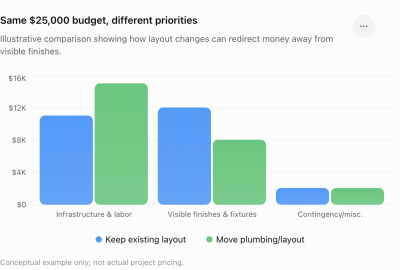
Imagine two homeowners each have exactly $25,000.
Homeowner A keeps the existing layout, chooses a good midrange vanity, uses attractive but reasonably priced tile and puts the money into a quality shower, waterproofing and installation.
Homeowner B moves the toilet, relocates the shower plumbing, chooses expensive tile and adds complicated design details.
Same budget.
Completely different amount of money available for the visible finished bathroom.
Same $25,000 budget, different priorities
That’s why designing to a budget is usually smarter than designing everything first and asking what it costs afterward.
Where Should You Spend More?
If I were prioritizing a bathroom budget, I’d put money into the things that are difficult or expensive to redo later:
Waterproofing. Plumbing and electrical work. Proper preparation. Quality installation. A functional layout.
You can replace a mirror. You can replace a faucet. You can repaint a wall.
You don’t want to tear apart a tiled shower because somebody tried to save a few hundred dollars behind the wall.
Where Can You Save?
Saving money doesn’t have to mean buying junk.
Some of the smartest cost-control decisions are surprisingly simple:
- Keep plumbing fixtures in their existing locations when the layout already works.
- Choose attractive standard-size tile instead of unnecessarily complicated patterns.
- Use a quality stock or semi-custom vanity instead of immediately jumping to custom cabinetry.
- Decide on fixtures before construction begins.
- Separate must-haves from nice-to-haves.
- Spend money on construction quality before decorative upgrades.
There’s a major difference between reducing the scope intelligently and cutting corners.
We strongly prefer the first one.
The Question Isn’t “Can I Get a Bathroom for Less?”
You probably can. You can also spend considerably more than $25,000. That’s why price by itself isn’t enough information.
The better questions are:
What exactly is included?
What isn’t included?
What materials are being used?
Is the layout changing?
How is the shower being waterproofed?
What happens if demolition reveals a problem?
Who is responsible for the project from demolition through completion?
Those questions tell you much more about an estimate than the number at the bottom.
So, Where Does the $25,000 Go?
It doesn’t disappear into a bathtub. It gets divided among dozens of materials, multiple trades, demolition, disposal, preparation, waterproofing, plumbing, electrical work, installation, finishing and project coordination.
And that’s really the lesson.
A bathroom remodel isn’t expensive because the room is big. It’s expensive because of how much has to happen correctly inside a very small space.
If you’re planning a bathroom remodel in Cleveland or Akron, Ohio or a surrounding city, Spot-On Home Improvements can help you determine what makes sense for your house, your goals and your budget.
Our goal isn’t to convince every homeowner to spend more.
It’s to help you understand where your money is going—and make sure you’re spending it on the things that matter.
FAQ
Is $25,000 enough for a bathroom remodel?
It can be. The answer depends on bathroom size, existing conditions, material selections, layout changes and the scope of work. A $25,000 cosmetic renovation and a $25,000 full renovation are very different projects.
What is usually the biggest expense in a bathroom remodel?
Collectively, skilled labor and project execution can represent a substantial portion of a full remodel. Tile work, plumbing, shower construction and material selections can also significantly affect the budget.
Is it cheaper to keep the toilet and shower in the same location?
Generally, yes. Keeping plumbing fixtures in their existing locations can avoid some of the labor and material costs associated with relocating drains, water lines and other plumbing.
Should I budget for unexpected bathroom remodeling costs?
For an older home especially, it’s prudent to maintain a contingency. Demolition can reveal water damage, deteriorated subfloors, outdated components or previous repairs that weren’t visible beforehand.